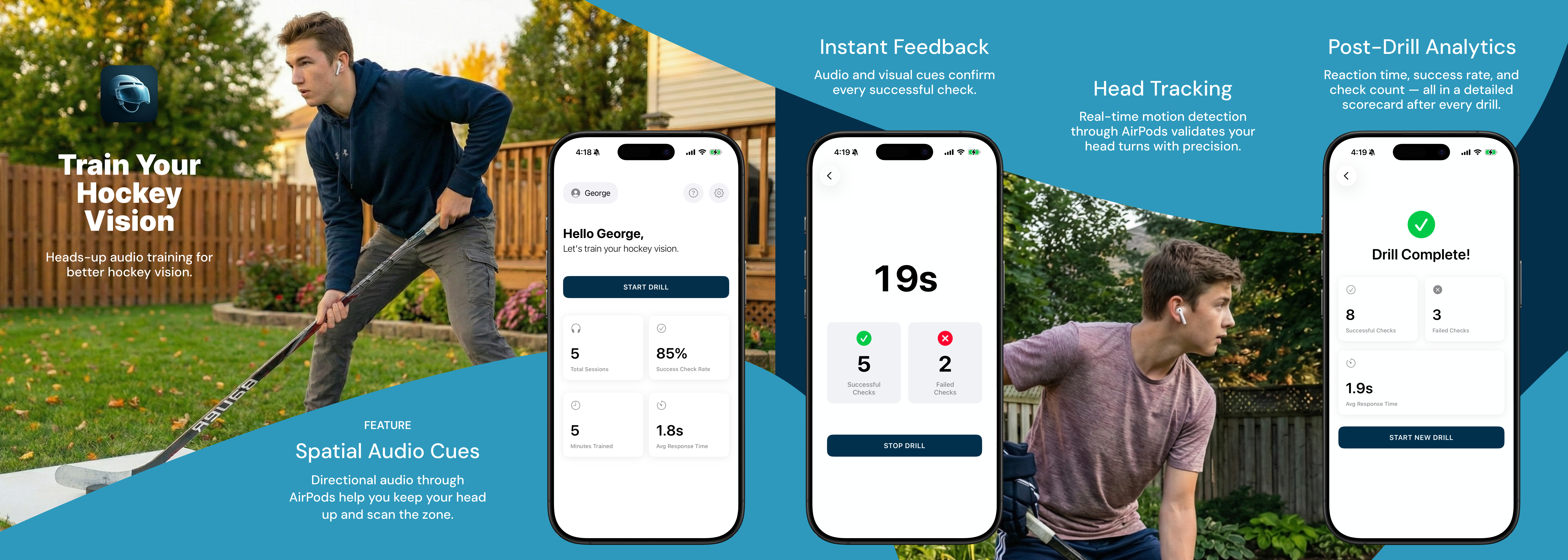
HockeyVision is an iOS app designed to train hockey players’ heads-up awareness using spatial audio cues from AirPods. The app uses motion tracking to detect head turns and provides real-time feedback on reaction times and success rates.
The motivation
After using Claude Code almost daily for productivity, I wanted to learn how to use it to build products. I decided to start a project. I wanted a project that would give me a foundational undersatnding of building & shipping a product end-to-end, using AI-native product development, and I wanted to build something personaly useful. Not another generic app, but something that solved a real problem and that took a novel approach to doing so.
The idea
I had been following Beebot, a new project from Dennis Crowley — the founder of Foursquare. The concept was simple but striking: use AirPods to push audio snippets about the people, places, and events around you. Location-awareness delivered through AI audio experiences. Crowley framed it as “BeeBot for AirPods,” and something about that framing clicked. AirPods aren’t just an audio device — they’re a spatial interface.
I used Gemini to come up with some ideas for iOS apps that take advantage of AirPods as a voice-first experience, which surfaced an interesting idea around using the motion accelerometers in AirPods to track head position relative to the spine to help improve posture. It turns out there’s lots of apps already that target similar solutions. But the motion accelerometer was interesting. I then asked for a complete listing of all the APIs available for AirPods, includiniig motion tracking, and then to come up with use cases for each based on my interests and hobbies.
One of the use cases was using the yaw (rotation) data from AirPods to improve heads-up awarness while playing hockey.
This was it.
I’ve been playing hockey for a few years. I’m still learning, but my skating has improved, my stickhandling is more reliable, and I fall less. What hasn’t come as quickly is hockey IQ — the mental side of the game. Keeping your head up while handling the puck. Scanning the ice to read where players are. Knowing where to position yourself. Recognizing passing lanes before the play forces your hand. It’s a different kind of skill, and it takes time.
My version of this problem is pretty common: I keep my head down. When I’m stickhandling, my eyes are on the puck. When I’m racing to a loose puck or driving to the net, I’m not keeping my head up. So I miss my shot or make poor passes. It’s the gap I’ve wanted to close most, and also the one that feels hardest to practice alone.
The implementation
It’s been years since I built an iOS app, so I was excited to get back into it — this time using AI.
- I used Gemini to write a PRD.
- I used Claude Code to build the iOS app, using Xcode as the IDE.
- I used Claude Code to build the marketing site, using Cursor as the IDE.
- I used Gemini and GPT 5 for marketing images, including designing the app icon.
- I used ElevenLabs for all the voice cues within the drills.
I was able to get the first prototype up and running on my local device in just a few hours — and took another week or two building & iterating.
The app opens with Google or Apple Sign-In, using Firebase for identity management, then asks for one thing: your name. That’s the profile. Each account supports up to four of them — a decision that sounds minor until you consider parents tracking two youth players. Each profile keeps completely independent stats and history, so progress never bleeds between users.
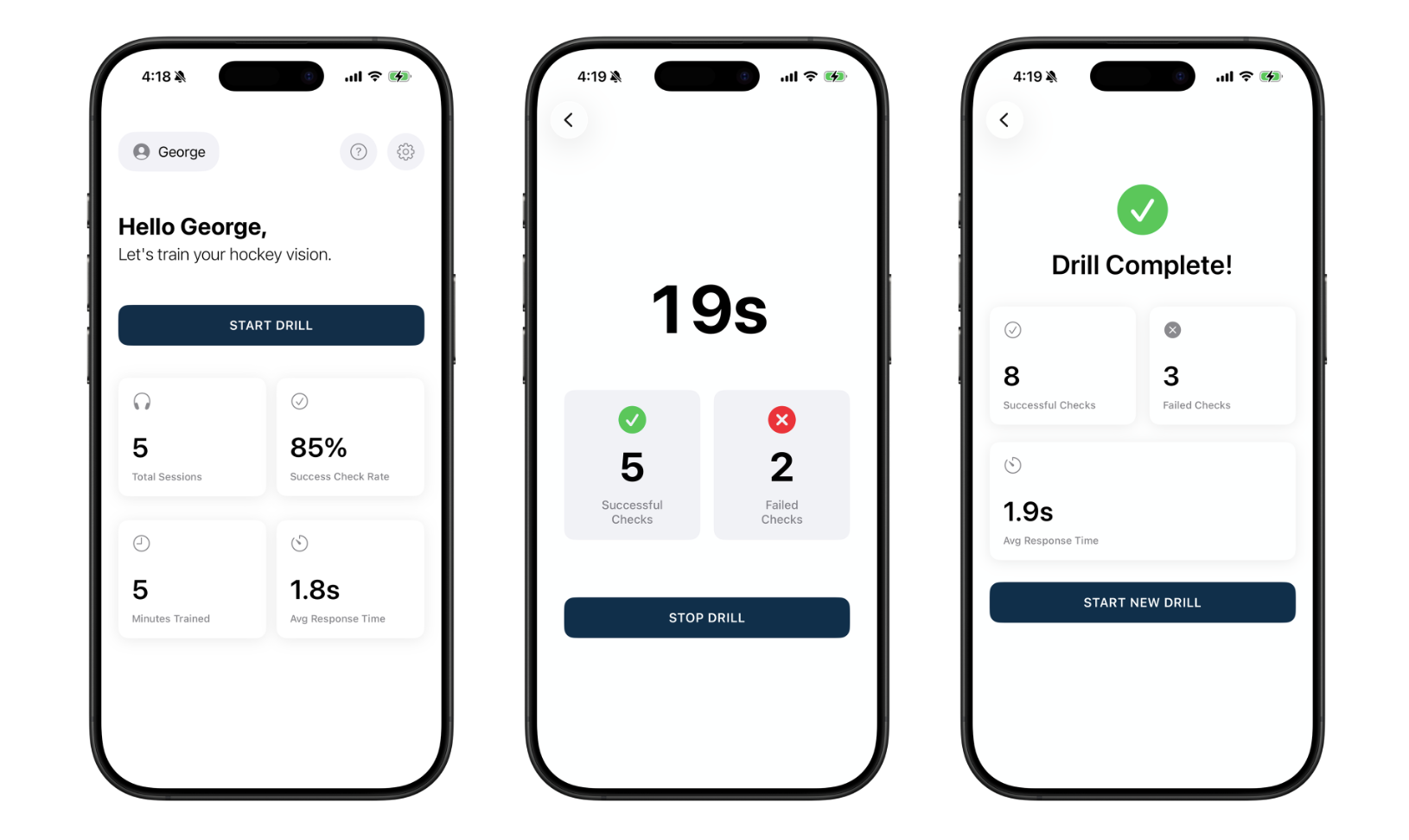
The home screen allows you to start a drill, run through a tutorial, and view a summary of your drill stats: total sessions, success rate, minutes trained, and average response time.
Each drill is 60 seconds. You put in your AirPods, tap Start Drill, and the app begins playing spatial audio cues like “Check left”. Your job is to turn your head quickly and accurately (preferrably while stickhandling). The AirPods’ motion sensors read your yaw rotation in real time, detecting if you turned your head and your response time. It will also tell you to “look up” if you’re keeping your head down too much. After the drill, you see the full breakdown. Success rate. Checks completed. Average response time. Misses. These results feed back into your profile stats on the home screen.
What’s next
It was incredible to be able to ideate, define, and build a product end-to-end — and do so quickly.
The app is currently in TestFlight being tested by friends, but hope to submit HockeyVision to the App Store soon. I’ll update this page when it’s available.